
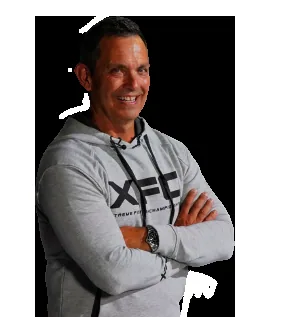
XFC Announces Executive Leadership For The Relaunch
Before a promotion can announce fights it has to announce who is running it, and the XFC used the early part of its relaunch to confirm the leadership team that would oversee the comeback. The board turned to executives who already knew the organisation from the inside, which signalled continuity rather than a clean break with the previous era. The appointments covered the business side, fight operations and media, the three areas any promotion has to get right at the same time if it wants a calendar that actually runs.
A leadership team drawn from inside the sport
The most visible appointment was that of the promotion's president, who had been with the brand through its expansion years and was asked to lead the rebirth of the organisation from 2020 onward. Public statements from the company credited that leadership with turning the XFC into a global entity embraced by the industry and by fans, and with building a model that blended high production values with an aggressive event schedule across several territories.
Alongside the president, the corporate side was anchored by a chief executive with a long media background who had previously held senior roles at large broadcast and entertainment companies. That experience is directly relevant to a promotion whose economics depend on television and streaming partners rather than on ticket revenue alone, and it explains why the corporate announcements were framed in the language of distribution and audience rather than of fights.

The role of fight operations
Fight operations is the department that converts a business plan into an actual card. It covers matchmaking, medicals, rules meetings, officiating and the logistics of getting athletes to a venue and onto a scale on time. In a promotion that runs tournaments, it also means maintaining brackets that survive injuries and late replacements without collapsing into mismatches or cancelled bouts.
The XFC has described its fight operations leadership as a matchmaker with more than a decade of experience discovering talent and placing athletes into larger organisations, which is the profile a scouting-led promotion needs. Someone in that seat has to balance a fighter's development against the short-term need for competitive bouts, and the two goals do not always point the same way.
- Matchmaking and division-by-division roster planning.
- Medical clearance and regulatory paperwork for every bout.
- Tournament brackets and short-notice replacement policy.
- Event logistics from weigh-in to walkout.
Why leadership mattered to the relaunch
Promotions in transition tend to fail in one of two ways: they either announce fights they cannot deliver, or they deliver events that do not build anything beyond the night itself. A leadership team that already understands the company's history is better placed to avoid both mistakes, because it knows which promises were kept the last time and which partners walked away.
Continuity also reassures the two groups that matter most in the short term. Fighters under contract want to know who is signing the cheques and who is picking their opponents, while broadcast partners want a stable point of contact for scheduling. Both questions are answered by naming an executive team and stating what each member is accountable for.
How the structure fits together
The table below sets out the executive functions confirmed around the relaunch and what each one is responsible for. Titles and responsibilities are summarised from the promotion's own corporate material, and the reporting lines are indicative of how sports properties of this size are normally organised.
| Function | Focus | Reporting line |
|---|---|---|
| Chief executive | Corporate strategy and media | Board of directors |
| President / COO | Day-to-day operations and relaunch | Chief executive |
| Fight operations | Matchmaking and event delivery | President |
| Media distribution | Broadcast deals and reach | Chief executive |
| Advisory board | Sporting and broadcast guidance | Board of directors |
The wider corporate picture
The XFC is a publicly traded company and a wholly owned subsidiary of Duke Mountain Resources, Inc., which means its announcements are written for shareholders as well as for fans. Executive appointments are therefore framed in commercial terms: who is accountable for distribution, who is accountable for operations, and what each appointment is expected to deliver over the coming cycle.
For supporters the practical consequence is simple. A promotion that names its leadership and states its responsibilities is a promotion you can hold to account. The next announcements to watch concern venues, broadcast windows and roster signings, and those appear in this section and on the Schedule as they are confirmed.
The three departments that decide a season
A promotion's calendar is run by three functions that have to agree before anything is announced. Fight operations decides who is available and who is medically cleared, matchmaking decides which of those athletes makes a competitive bout, and media distribution decides when the resulting card can actually be televised. When any one of the three moves on its own, the result is a bout that is either unmatched, uninsured or unwatchable.
That is why leadership appointments are usually announced as a group rather than one at a time. Naming a single executive tells the industry who to call; naming a team tells it what the promotion intends to prioritise. In the case of the relaunch, the emphasis on distribution and fight operations at the same time suggested a company that expected to be judged on both the cards it delivered and the screens they appeared on.